Guyana
Updated: Mar 16
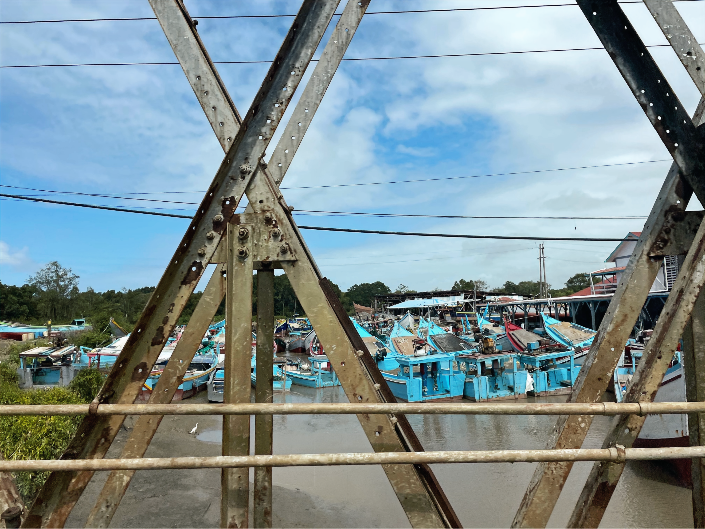
The last country in the Guyanas, was Guyana. This is the biggest of the three, both counting the area and the size of the population. Our first stop after the ferry across the Courantyne River was New Amsterdam where we spent the first night. The border crossing took a very long time as there was only a couple of ferries per day, and it was a long time to wait in the queue. We also spent a considerable amount of time buying the mandatory car insurance, with a person from the border accompanying us and handing over the paperwork we needed only once we had paid. Another thing that took a lot of time was to find an ATM that accepts foreign cards, and get cash out. The economy runs on cash.
Driving to Georgetown, the capital, the following day was straight forward, but the traffic was slow as the total distance was going in built-up areas. There is the one road, and people live on either side of it, so everybody is moving around there. We saw a lot of school children on their way to start their day. They had strict school uniforms, and other officials, like police, also wore strict uniforms of different colours depending on their status.
Arriving to the capital, we went to Starbucks for coffee. We were a bit starved of coffee, and it happened to be side by side with a huge supermarket, where they sold all sorts - including Waitrose baked beans and bottled water. Finding a hotel wasn't difficult, but everything in Guyana is incredibly expensive. Our city guide told us that the prices on everything is three times those in Germany. The reason for this is a bit obscure, but his take was that nobody wants to work so they try to get as much as possible out of visitors. A pretty average hotel room was USD315/night. Plus taxes and fees. Nothing much is grown in Guyana, and importing all your food and other necessities from neighbours do get expensive. The country has found enormous oil deposits in the sea, and is set to become very wealthy. It will be interesting to follow how that wealth will benefit the total population, as right now there are many poor people.
After Georgetown we started our drive towards Lethem. This was to be our exit point, taking us back to Brazil. The drive is some 10 to 12 hours, stretching 460km, and we agreed to go to a kind of mid point at Kurukukari, where there is a hotel and research center Iwokrama River Lodge, to spend the night. The drive started out well enough with a lot of traffic in both directions on the only road out. We knew that the road would be sealed up to Linden, and after that it would be anybody's guess. And so it was, as after Linden we hit the road that is still to be built. It was raining, and the wet, red mud covered the car completely. It took about 6 hours to drive the first half to Kurukukari, where we took the ferry across the river to find the hotel in beautiful grounds along the Essequibo River. We were told we could roam freely on the grounds, but not enter the forest without a guide, and not go in the river as there is a black cayman who sometimes lurks next to the boat ramp. They also said that there are malaria mosquitos in the jungle, but they have never had a case of malaria.
The last leg to Lethem was the worst, which really means terrible considering our experience with the mud. We started off with more mud and the drive went through the jungle. About two hours in, we arrived to the savanna area, which is dry and creates a road surface like a washboard. It was also uneven and full of stones, so it was slow. At times we drove for what felt like hours at 15km/hour, and we arrived after some 6,5 hours to desperately try and find a car wash and a hotel with a gated car park. We achieved that, after some time, and spent our last night in Guyana in a hotel that had a few rooms ready and the rest was a construction zone.
Sunday morning we left Lethem early, passed the border without any trouble, and found ourselves back in Brazil.